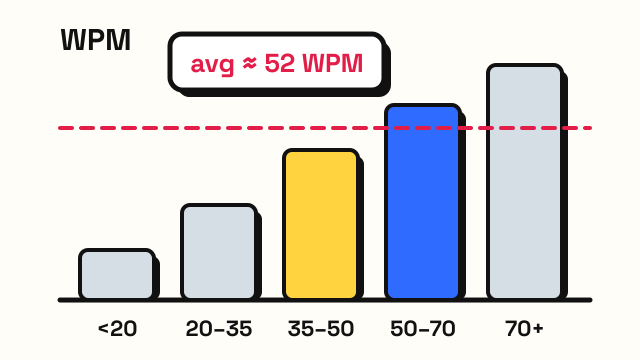
The average typing speed for adults on a computer keyboard is usually put at around 40 words per minute (WPM). That figure gets repeated so often that it has become a rule of thumb rather than a precise measurement, and real numbers vary a lot with age, practice and the kind of text being typed. This guide explains the ranges people commonly use, what counts as a good speed for work, and how to measure your own number fairly.
What is the average typing speed?
Most typing sites, teachers and hiring guides describe the average adult as typing somewhere between 35 and 45 WPM on a physical keyboard. People who learned to touch type and use a keyboard daily tend to sit above that. People who type with two or four fingers while watching the keys tend to sit below it.
The largest published study of keyboard typing points a little higher. Researchers at Aalto University analysed about 136 million keystrokes from roughly 168,000 volunteers who took an online typing test, and found an average of about 52 WPM, with the fastest 5% above 80 WPM (Dhakal et al., CHI 2018). The volunteers chose to take a typing test, so they probably type more than the average person, which is one reason the everyday rule of thumb stays closer to 40 WPM.
Keep two things in mind when you compare yourself with "average":
- The text matters. Short, common words are much faster to type than long words, numbers or code. A test full of words like "the", "and" and "with" will produce a higher WPM than a paragraph of technical writing.
- The method matters. Some tests count only correct characters (net WPM), others count everything you typed (raw or gross WPM). The same person can score 10 WPM apart depending on which one is shown. Our guide on how WPM is calculated walks through the difference.
Typing speed ranges by level
The table below uses ranges that are widely quoted across typing tutors and job sites. Treat them as rough bands, not official grades.
| WPM | Level | What it usually looks like |
|---|---|---|
| Under 20 | New learner | Looks at the keyboard for most keys, often uses a few fingers |
| 20–35 | Below average to average | Knows where keys are but hesitates on less common letters |
| 35–50 | Average to above average | Comfortable with everyday typing, some touch typing |
| 50–70 | Fast | Touch types without looking, few pauses between words |
| 70–90 | Very fast | Types in a steady rhythm, rarely stops to correct |
| 90+ | Expert | Competitive typists, professional transcriptionists |
Accuracy sits next to speed in every one of these bands. A 60 WPM result at 88% accuracy is less useful than 50 WPM at 97%, because every mistake costs time to spot and fix in real work.
Average typing speed by age group
You will find charts online that list average WPM by age. Be careful with them: many do not say where their numbers come from. What can be said with confidence is more general:
- Children type slower than adults, mostly because they are still learning letter positions and spelling at the same time. Speed usually climbs quickly once they learn the home row.
- Teenagers and young adults who grew up typing every day for school often reach 40–60 WPM, especially if they had typing lessons.
- Older adults vary the most. Someone who trained on a typewriter decades ago may still type 70 WPM, while someone who started using computers later in life may type 20.
In other words, practice and method predict speed far better than age does.
What typing speed do jobs require?
Job listings that mention typing usually ask for a specific WPM and sometimes a minimum accuracy. The figures below are common in postings, but each employer sets its own bar.
| Type of role | Speed often requested |
|---|---|
| General office, reception, customer support | 35–45 WPM |
| Administrative assistant, data entry | 40–60 WPM |
| Legal or medical secretary | 60–75 WPM |
| Transcriptionist, captioner | 70 WPM and up |
Many of these assessments run for longer than one minute, often three or five minutes, because a short test can be skewed by a lucky or unlucky start. If you are preparing for one, practice with the 5 minute typing test so the length feels normal on the day.
How to measure your typing speed
A single one-minute test gives you a snapshot. A fair measurement takes a little more care:
- Warm up first. Type for a couple of minutes before you record a score. Cold fingers make more mistakes.
- Use the right keyboard. Test on the keyboard you actually use for work. Laptop, desktop and phone keyboards give different results.
- Take three tests and look at the middle score. One great run is not your average, and one bad run is not either.
- Check accuracy, not just WPM. If accuracy is under 95%, slow down on the next attempt.
- Repeat weekly. Improvement shows up over weeks, not days.
You can take the free typing test here. It shows your WPM, raw WPM, accuracy and the keys you missed most, and it keeps your recent results in your browser so you can compare them over time.
Is 40 WPM good?
40 WPM is a solid, useful speed. It is enough for emails, school work and most office jobs, and it matches the figure most often given as the adult average. Whether it is "good" depends on what you need. If a job posting asks for 50 or 60 WPM, you have some work to do. If you type a few messages a day, 40 WPM is plenty.
The more useful question is whether you are typing at 40 WPM by touch or by looking. Someone who reaches 40 WPM while watching the keys has likely hit a ceiling. Someone who reaches 40 WPM by touch usually keeps improving with practice.
How to get above average
The fastest route past the average is learning to touch type with all ten fingers. If you are not there yet, start with the home row lesson and work through the levels in order. If you already touch type, focus on accuracy and rhythm, then on your weakest keys. The guide on how to type faster covers a practical plan.
Frequently asked questions
What is the average typing speed in WPM?
The figure most often cited for adults is about 40 WPM on a physical keyboard, with a common range of roughly 35 to 45 WPM. Touch typists who type daily are often faster.
What is a good typing speed for a job?
Many office and support roles ask for 35 to 45 WPM. Data entry and administrative roles often ask for 40 to 60 WPM, and transcription work usually asks for more. Accuracy of 95% or higher is often expected too.
Is typing speed measured with or without mistakes?
It depends on the test. Net WPM counts only correct characters, while raw or gross WPM counts every character typed. Our test shows both, so you can see how much mistakes are costing you.
How long should a typing test be to get an accurate result?
One minute gives a quick reading. Three to five minutes is steadier because it smooths out a fast start or a single stumble, which is why many job assessments use longer tests.
Sources
- Dhakal, V., Feit, A. M., Kristensson, P. O. and Oulasvirta, A. (2018). Observations on Typing from 136 Million Keystrokes. Proceedings of the 2018 CHI Conference on Human Factors in Computing Systems.
- Palin, K., Feit, A. M., Kim, S., Kristensson, P. O. and Oulasvirta, A. (2019). How do People Type on Mobile Devices? Observations from a Study with 37,000 Volunteers. Proceedings of MobileHCI 2019.