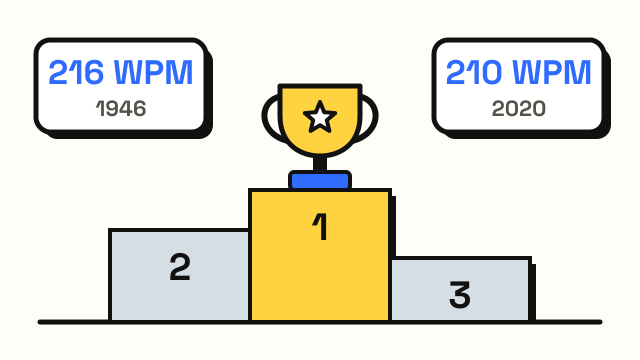
There is no single official answer, because the "fastest typist in the world" depends on the machine, the length of the test and who checked the result. The best documented records are Stella Pajunas's 216 words in one minute on an IBM electric typewriter in 1946, which Guinness World Records still lists, and Anthony "Chak" Ermolin's 210.4 WPM race at the 2020 Ultimate Typing Championship, where he averaged 180.88 WPM over five races. Short bursts on typing websites go higher, but those are self-run and measured in different ways. This guide sorts the records by how they were measured, so you can see which numbers mean what.
What are the verified typing speed records?
The table lists records that come from Guinness World Records or from the official results of a live competition. Each one measured something slightly different, so read the "test" column before comparing them.
| Typist | Speed | Test | Year | Verified by |
|---|---|---|---|---|
| Stella Pajunas | 216 words | One minute, IBM electric typewriter | 1946 | Guinness World Records |
| Carole Bechen | 176 WPM net | Five minutes, manual typewriter | 1959 | Guinness World Records |
| Albert Tangora | 147 WPM net | One hour, manual typewriter, ten-word penalty per error | 1923 | Guinness World Records |
| Sean Wrona | 163 WPM | One race on a 574-word standard text, computer keyboard | 2010 | Ultimate Typing Championship final |
| Anthony "Chak" Ermolin | 210.4 WPM peak, 180.88 WPM average | Five online races in the final | 2020 | Ultimate Typing Championship final |
The typewriter records are old but were set under formal conditions, with errors subtracted from the score. The championship results are newer and come from short races on computer keyboards.
Who was Barbara Blackburn, and is 212 WPM real?
Barbara Blackburn is the name most lists give as the fastest typist ever. She typed on the Dvorak layout and was listed in the Guinness Book of World Records under "Typing, Fastest" in the 1976 to 1986 editions, credited with bursts of 170 WPM and a sustained 145 WPM for 55 minutes.
The 212 WPM figure that appears on many websites is a different matter. It was her own claimed peak speed for a brief burst, not a Guinness-certified result. Guinness also dropped its typing speed records for electronic and computer keyboards, including hers, from the 1987 edition onward, citing doubts about their accuracy. So Blackburn was clearly an exceptional typist, and her Guinness entries were real, but 212 WPM is best read as an unverified peak.
Her story is also why the Dvorak layout has a reputation for speed. Whether the layout or the typist deserves the credit is still argued about. Our guide comparing QWERTY, Dvorak and Colemak covers what the evidence does and does not show.
Who is the fastest typist today?
The strongest current claim belongs to the winner of the Ultimate Typing Championship, a live tournament run by the keyboard maker Das Keyboard.
- 2010. The first championship was held at the SXSW Interactive festival in Austin. Sean Wrona beat Nate Bowen 163 to 110 WPM on a standard text, then 124 to 79 WPM on a harder text with more punctuation, and won the title.
- 2020. The championship returned as an online tournament, raced on the Typrx typing site. Anthony Ermolin, known as Chak, beat Wrona in the final, averaging 180.88 WPM across five races with a best race of 210.40 WPM. Wrona averaged 172.72 WPM.
The drop from 163 WPM to 124 WPM between the two 2010 rounds is worth noticing. The same typist on the same day lost almost 40 WPM when the text got harder. That is why records only mean something next to the text they were set on.
Why do typing records disagree so much?
If you search for the fastest typing speed, you will find numbers from about 150 to well over 300 WPM. Most of the gap comes from four things:
- Test length. A five-second burst is far easier than a one-hour test. Tangora's 147 WPM was held for an hour; most online records last 15 to 60 seconds.
- The text. Short common words such as "the" and "and" are faster to type than real sentences with capitals, numbers and punctuation. Some sites use a short list of frequent words, which inflates speed.
- Gross or net speed. Gross (raw) WPM counts every keystroke. Net WPM subtracts errors, and old typewriter contests subtracted heavily. Our guide on how WPM is calculated explains both.
- Who checked it. A Guinness adjudicator or a live audience is stronger evidence than a screenshot. Online leaderboards on sites such as TypeRacer and Monkeytype show sprint scores well above the championship results, but each site uses its own rules, text and checks.
Online sprint scores are not fake; they measure peak burst speed on easy text rather than sustained speed on ordinary writing.
How do other typing records work?
Guinness World Records also keeps narrower typing records that are easier to verify on camera. The best known is the fastest time to type the alphabet on a computer keyboard, A to Z in order with no mistakes. At the time of writing, Guinness lists 3.25 seconds by Shashank in Karnataka, India, set in February 2024. There are separate categories for typing with one hand, on a tablet, on a phone touchscreen and for children under 16, and these records change often, so check the Guinness site for the current holder.
These records reward one memorized sequence of 26 keys, so they say little about everyday typing. The Typing Challenge game has a similar feel: short, exact and timed.
How does your speed compare to the record holders?
Record holders are far from normal, even among keen typists. In the largest published study of keyboard typing, researchers at Aalto University and the University of Cambridge analysed 136 million keystrokes from about 169,000 volunteers who took an online typing test. The average was 51.56 WPM, and only the fastest few reached 120 WPM or more (Dhakal et al., 2018). The average adult is usually put at around 40 WPM, as the average typing speed guide explains.
| Speed | Where it puts you |
|---|---|
| 40 WPM | Around the commonly cited adult average |
| 52 WPM | About the average in the Aalto study |
| 80 WPM | Well above average, enough for any office job |
| 120 WPM | Among the fastest people in the Aalto data |
| 160 WPM and up | Championship territory |
If you want a fair number of your own, take the 3 minute typing test a few times and use the middle score. To see how you rank against other people rather than against averages, race in Typing Race or post a score on the daily leaderboards.
How do the fastest typists train?
Top typists describe the same basics:
- Touch typing first. Nobody at record speed looks at the keys. If you still do, start with the typing lessons and the guide on how to stop looking at the keyboard.
- Accuracy before speed. Errors cost more time than they save. The typing accuracy guide shows how to keep errors low while speed climbs.
- Short daily sessions. Regular practice beats occasional long sessions, and a quick test each week shows whether it is working.
For a full plan, read how to type faster.
Frequently asked questions
What is the highest typing speed ever recorded?
The highest figure in a Guinness World Records entry is 216 words in one minute, typed by Stella Pajunas on an IBM electric typewriter in 1946. Higher numbers exist on typing websites, but they come from short self-run tests rather than independently checked records.
Is 200 WPM possible?
Yes, for short races. Anthony Ermolin reached 210.4 WPM in one race of the 2020 Ultimate Typing Championship final. Holding 200 WPM on ordinary text for several minutes is something very few people, if any, have been shown to do.
Does Guinness still have a typing speed record?
Guinness still lists historic typewriter records, such as Stella Pajunas's 216 words in a minute and Albert Tangora's 147 WPM for an hour, along with newer records like the fastest time to type the alphabet. It dropped its keyboard speed records for electronic and computer keyboards from the 1987 edition onward.
What keyboard layout do the fastest typists use?
Both QWERTY and Dvorak typists have held records. Barbara Blackburn used Dvorak, while the typewriter records of the 1920s to 1950s were set on QWERTY, the standard layout of the time. Years of practice matter far more than the layout.
Sources
- Guinness World Records. Fastest typist on an electronic typewriter, Fastest typist on a manual typewriter in a five minute test, Fastest typist on a manual typewriter in an hour test and Fastest time to type the alphabet.
- Wikipedia. Barbara Blackburn (typist) and Ultimate Typing Championship.
- Das Keyboard via Business Wire (2020). Das Keyboard Announces Winners of the Ultimate Typing Championship 2020 and Crowns Best Typist on the Planet.
- Dhakal, V., Feit, A. M., Kristensson, P. O. and Oulasvirta, A. (2018). Observations on Typing from 136 Million Keystrokes. Proceedings of the 2018 CHI Conference on Human Factors in Computing Systems.