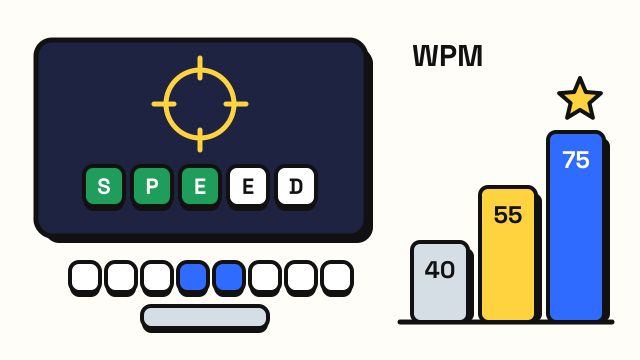
Typing games build real speed for adults when they make you type real words and sentences, reward accuracy as well as pace, and push you slightly past your comfortable speed. Games that only flash single letters, or that let you mash keys to win, are fun but do little for everyday typing. The best approach is to pick a game for the skill you are missing, play short rounds while keeping your fingers on the home row, and check a typing test every week to see whether the speed is carrying over.
Do typing games actually make you faster?
They can, but only if the game trains what makes typists fast. The largest study of everyday keyboard typing, which analysed data from about 168,000 volunteers, found that faster typists generally make fewer mistakes and that the fastest rely on "rollover": pressing the next key before releasing the previous one (Aalto University, 2018). The researchers also found that letter pairs typed with different hands or fingers predicted speed better than other features (Dhakal et al., CHI 2018).
In practice that means a good game should:
- Use whole words and sentences, so your fingers learn common letter pairs and the flow from one key to the next.
- Cost you something for mistakes, such as a broken combo, a lost life or a stop until you fix the error. Otherwise you learn to rush.
- Raise the pace gradually, so you spend time just above your comfortable speed rather than far below or far beyond it.
- Keep your eyes on the screen. Most games move fast enough that looking down costs you, which is a useful nudge toward touch typing.
Games don't teach finger placement. If you still look at the keys, short typing lessons do that job better.
What makes a typing game good for adults?
Many typing games are built for school children, with very short words. Adults usually want:
- Real text at adult reading level, including capitals, punctuation and longer words.
- Difficulty that reaches 60 WPM and beyond, so the game still has something to teach once you are past the basics.
- Short rounds with a clear result. A few minutes per round, with WPM and accuracy at the end.
- No sign-up wall. You should be able to try a game before handing over an email address.
Which typing game trains which skill?
All of our typing games run in the browser with no download and no account. Each one leans on a different skill, so the useful question is not "which is best" but "what am I missing?"
| Game | Main skill it trains | Built-in pace |
|---|---|---|
| Typing Race | Steady speed over full passages | Rival lineups built for about 40, 55 and 75 WPM |
| Typing Challenge | Stamina and pushing past your top speed | Starts at 15–90 WPM, 5% faster every 30 seconds |
| Monster Typing Game | Accuracy on whole words | Easy, Normal and Hard word sets |
| Zombie Typing Game | Fast starts on new words under pressure | Easy, Normal, Hard built for about 20, 35 and 55 WPM |
| Space Typing Game | Many short words, quick target switching | Easy, Normal, Hard built for about 20, 35 and 55 WPM |
| Typing Fighting Game | Reaction and choosing targets | Waves, then a boss with full sentences |
Typing Race: steady speed on real passages
Typing Race is the closest of our games to a typing test. Every correct letter moves your runner forward, so your WPM is your running speed, and a wrong letter stops you until you fix it. Three rivals run with you, each at a set speed and style: some sprint early and fade, some hold an even pace, some finish with a late burst. The Pro lineup runs at 44 to 58 WPM and the Legend lineup at 58 to 79 WPM, which makes it a good way to hold a pace just above your own for a minute or more.
Typing Challenge: stamina and top speed
Lines from classic books and well-known quotes scroll up the screen, and you have to finish each one before it reaches the red line. You choose a starting speed of 15, 30, 50, 70 or 90 WPM, and the scroll gets 5% faster every 30 seconds. That steady climb is what makes it useful for adults who have plateaued: every run ends just past what you can sustain. The texts include capitals and punctuation, so the practice transfers to emails and documents.
Monster Typing Game: accuracy first
Each correct word throws an attack at a monster, and one mistake resets your combo. The combo rule is the habit many adult typists need to rebuild: slow down slightly and get every word right. The Daily Monster gives everyone the same words each day, which makes a two-minute daily round easy to keep up.
Zombie, Space and Fighting games: pressure and quick starts
In these three you type the first letter to lock on to a target, then finish its word. Targets keep coming, so you practise starting new words instantly instead of pausing between them. The Space game adds a dodge command you type when a missile is fired, and the Fighting game lets you parry an enemy by finishing its word in time. They suit typists who already know the whole keyboard and want reaction practice.
Other well-known typing games for adults
We are not the only option. TypeRacer, launched in 2008, lets you race other people online by typing passages from books, films, songs and TV shows, and errors must be corrected before you can move on. Z-Type, made by Dominic Szablewski in 2011, is a browser space shooter where each correct keystroke fires at incoming words and fewer errors give a higher score. Both are popular with adults and both reward clean typing.
How to use typing games without wasting time
- Warm up with a lesson or drill first. Five minutes of accurate practice before a game keeps the game from undoing your technique.
- Pick difficulty by your test result. Take the 1-minute typing test and choose a level built for a speed slightly above yours.
- Watch accuracy, not only score. If your accuracy at the end of a round drops below about 90%, play the next round slower. The guide on how to improve typing accuracy explains why accuracy drives speed.
- Stay on the home row even when you lose. Hunting for keys may win one round, but it locks in the habit you are trying to break. See how to stop looking at the keyboard if this is hard.
- Keep sessions short and frequent. A classic study of adults learning to type found that shorter, spaced sessions learned more per hour than long, concentrated ones (Baddeley & Longman, 1978). Ten to fifteen minutes of games a day is plenty for most people.
- Test weekly. Once a week, take the same test and compare. If your game scores rise but your test speed doesn't, switch to a game with longer real text, such as Typing Race or Typing Challenge.
For a full routine that mixes lessons, games and tests, see our 30-day typing practice plan for adults.
Frequently asked questions
Are typing games better than typing lessons?
They do different jobs. Lessons teach which finger presses each key, and games add pressure, variety and a reason to come back. Adults who are still learning the keys get more from lessons first, then games.
What is the best typing game for adults to increase WPM?
A game that uses full passages and sets a pace slightly above yours works best for raw speed. Typing Race and Typing Challenge fit that description. If accuracy is your weak spot, start with Monster Typing Game.
How long should I play typing games each day?
Ten to fifteen minutes is a realistic target. Short daily sessions tend to help more than one long session a week, and stopping before you get tired keeps accuracy high.
Do typing games work on a laptop keyboard?
Yes. Our games are designed for a physical keyboard, and a laptop keyboard works fine. Play on the keyboard you use for work so the practice carries over.
Sources
- Dhakal, V., Feit, A. M., Kristensson, P. O. and Oulasvirta, A. (2018). Observations on Typing from 136 Million Keystrokes. Proceedings of CHI 2018.
- Aalto University. The traits of fast typists discovered by analysing 136 million keystrokes (2018).
- Baddeley, A. D. and Longman, D. J. A. (1978). The influence of length and frequency of training session on the rate of learning to type. Ergonomics, 21(8), 627–635.
- Wikipedia. TypeRacer and Z-Type.