Real typing jobs from home exist, but they are not the "earn $500 a day typing from your couch" ads that fill search results. The genuine work falls into four groups: transcription, captioning, data entry, and chat or email customer support. Most of these ask for 40 to 60 words per minute (WPM) with accuracy of 95% or better, and transcription platforms care more about clean, well-punctuated text than raw speed. This guide lists the real roles, the speeds they expect, what the pay looks like where a source exists, and how to tell a job from a scam.
Which typing jobs can you really do from home?
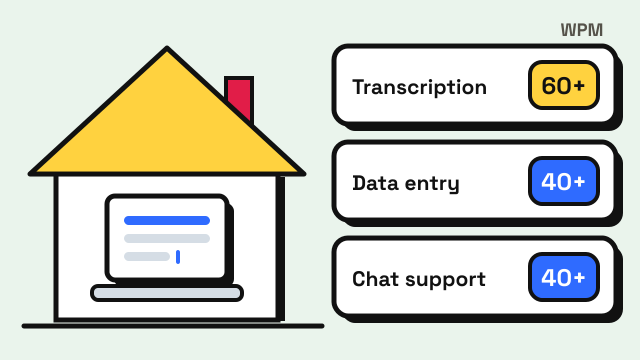
The table shows the main remote roles built around typing, the speed usually expected and how the work is measured. The speeds are the figures that appear in job listings and platform requirements; only the US federal clerical standard is an official number.
| Role | Typical speed asked | How you are measured |
|---|---|---|
| General transcription | 50–70 WPM, 98%+ accuracy | Per audio minute, with a quality score |
| Captioning and subtitling | 60–80 WPM offline; 180+ WPM on a stenotype for live work | Per video minute, with timing checks |
| Data entry | 40–60 WPM, often 8,000–12,000 keystrokes per hour | Keystrokes per hour and error rate |
| Chat and email support | 40–50 WPM, near-perfect spelling | Response time and customer ratings |
| Medical or legal transcription | 60–80 WPM plus training | Per line or per audio minute |
Two things stand out. First, the bar is lower than most people fear: the 40 WPM that the US Office of Personnel Management requires for federal clerk-typist jobs, measured on a five-minute sample with three or fewer errors, is the same bar most remote office work uses. Second, the roles that pay best per hour are the ones where accuracy, listening and formatting matter more than speed. The guide to typing speed for jobs covers office roles in more depth.
What do remote transcription jobs require?
Transcription is the most common entry point because platforms take freelancers with no prior experience. Rev, one of the largest, lists freelance transcription at $0.40 to $1.10 per audio or video minute, captioning at $0.54 to $1.10 per minute, and legal transcription at $0.55 to $2.00 or more. Applying means passing a short English and grammar assessment and submitting a sample transcript for review (Rev).
Notice what is missing: a WPM number. Platforms grade the sample on punctuation, speaker labels and style-guide compliance. Speed still decides your real hourly rate, because a one-hour recording takes a slow typist four hours and a fast one two, but accuracy is what gets you accepted. A useful way to practice both at once is Listen and Type, which plays a sentence and scores what you type, the same loop as transcription work.
Medical transcription is a separate track that needs training in terminology. The US Bureau of Labor Statistics puts the median pay for medical transcriptionists at $37,550 a year in May 2024 and projects employment to fall 5 percent from 2024 to 2034 as speech recognition takes over the first draft (BLS).
How fast do you need to type for captioning?
It depends on whether the video is already recorded. Offline captioning, where you transcribe a finished video and time the captions, is close to transcription, and most listings ask for 60 to 80 WPM with high accuracy. Live captioning for broadcasts, classrooms and courts is a different job done on a stenotype machine, not a keyboard. The National Court Reporters Association's entry-level Certified Realtime Captioner test runs five minutes at 180 WPM and requires 96 percent accuracy (NCRA). No ordinary keyboard typist reaches that, so an ad promising live captioning work with "basic typing skills" is a warning sign.
What does data entry from home actually involve?
Data entry is numbers, codes, names and addresses typed into forms, spreadsheets and databases. Because the text is not prose, employers often measure keystrokes per hour (KPH) rather than WPM, and listings commonly ask for 8,000 to 12,000 KPH with accuracy of 98 percent or more. The guide on WPM to CPM shows how the units relate, and the 3 minute typing test here reports keystrokes per hour alongside WPM.
Pay is modest: the BLS reports a median hourly wage of $18.17 for data entry keyers in May 2023 (BLS). Most legitimate remote data entry is contract work through staffing agencies or outsourcing companies, and it rarely pays more than that office rate. An ad offering $30 or $40 an hour for simple data entry with no experience is almost always a scam.
If numbers slow you down, spend a week on the numbers and symbols lessons.
Is chat support a typing job?
Partly. Remote support agents handle several chat windows at once, and slow or sloppy typing shows up directly in response times and customer ratings. Most listings ask for 40 to 50 WPM and flawless spelling. The BLS puts the median pay for customer service representatives at $42,830 a year in May 2024, with around 2.8 million people in the role (BLS). Many of those positions are now remote, which makes support one of the most common ways to turn solid typing into a salaried job with benefits.
How do you spot a typing job scam?
Job scams have grown fast. The Federal Trade Commission reports that job and employment agency scam reports tripled between 2020 and 2024, and the money people reported losing rose from $90 million to $501 million over the same period (FTC). "Work from home typing" is one of the oldest lures. The FTC's advice is short: never pay to get a job, whether the fee is for certification, training, equipment or supplies, and never answer ads that guarantee you will be hired or guarantee a large income (FTC consumer advice).
These signs mean walk away:
- You pay first. A registration fee, a starter kit, a required software licence or a "background check" you must fund yourself.
- A check arrives before any work. You are told to deposit it and send part on for equipment. The check is fake and the money you send is gone.
- The pay is out of line. Simple typing at two or three times the market rate, with no experience needed.
- The interview is only in a chat app. Real employers talk to you by phone or video and use a company domain, not a free email address.
- They ask for bank or ID details early. Legitimate employers collect those after a signed offer, not in the first message.
A real listing names the company, describes the task, states a rate per audio minute or per hour, and tests your skills before it talks about money.
How do you prove your typing speed?
Most platforms test you themselves, but a result of your own is useful on a profile or application. Take the 5 minute typing test, which matches the length used by formal job tests, and download the free typing certificate showing your WPM, accuracy and date. Be honest about what it is: a self-issued result, not a proctored credential.
Report a number you can repeat: run the test three times on different days and quote the lowest. If your accuracy is under 95 percent, work through how to improve typing accuracy first, since every role above counts errors against you. And if you work on a laptop, check that every key registers with the keyboard tester; a dead key found during a paid transcription job is an expensive discovery.
Frequently asked questions
Can I get a typing job from home with no experience?
Yes. General transcription and captioning platforms accept beginners who pass a grammar and sample test, and entry-level chat support often needs only a typing test and an interview. Expect low rates at first and better work once you have a quality score.
What typing speed do I need for work-from-home jobs?
Around 40 WPM with high accuracy is enough for data entry and support, matching the US federal clerical standard. Transcription and captioning run more smoothly at 60 WPM or more. Live captioning requires stenotype skills at 180 WPM and above.
How much do typing jobs from home pay?
Rev lists transcription at $0.40 to $1.10 per audio minute. The BLS median for data entry keyers was $18.17 an hour in May 2023, and for customer service representatives $42,830 a year in May 2024. Freelance typing pays by output, so a faster, more accurate typist earns more per hour.
Are "earn money typing" ads real?
Almost never. The FTC's rule is that you never pay to get a job, and no legitimate employer sends you a check and asks for part of it back. An ad promising guaranteed income for simple typing is a scam.
Sources
- Rev. Freelance transcription, captioning and legal transcription work (pay per audio or video minute, application steps).
- US Bureau of Labor Statistics, Occupational Outlook Handbook. Medical Transcriptionists (May 2024 median pay, 2024–34 projection).
- US Bureau of Labor Statistics, Occupational Outlook Handbook. Customer Service Representatives (May 2024 median pay, employment).
- US Bureau of Labor Statistics, Occupational Employment and Wage Statistics. Data Entry Keyers, May 2023.
- National Court Reporters Association. Certified Realtime Captioner (CRC) (skills test speed and accuracy).
- Federal Trade Commission. New FTC Data Show a Big Jump in Reported Losses to Fraud to $12.5 Billion in 2024 (job scam reports and losses, 2020–2024).
- Federal Trade Commission, Consumer Advice. Job Scams.
- US Office of Personnel Management. Group Coverage Qualification Standard for Clerical and Administrative Support Positions (40 WPM, five-minute sample).