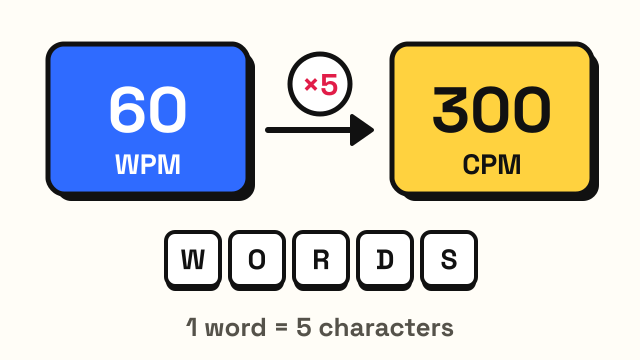
To convert WPM to CPM, multiply by 5. To convert CPM to WPM, divide by 5. So 40 words per minute is 200 characters per minute, and 300 characters per minute is 60 WPM. The factor is 5 because typing tests count one "word" as five characters, including spaces and punctuation. This guide shows the formulas, a ready-made conversion table, where the two units differ in practice, and why some typing tests and languages prefer CPM.
What is the formula for WPM to CPM?
Both units measure the same thing: how much text you produce in a minute. WPM simply groups characters into standard five-character words.
CPM = WPM × 5
WPM = CPM ÷ 5
A few quick examples:
- 30 WPM × 5 = 150 CPM
- 55 WPM × 5 = 275 CPM
- 400 CPM ÷ 5 = 80 WPM
- 225 CPM ÷ 5 = 45 WPM
If you need keystrokes per hour (KPH), the measure many data-entry jobs use, multiply CPM by 60. 200 CPM is 12,000 KPH, and 18,000 KPH ÷ 60 is 300 CPM, which is 60 WPM.
Why is one word five characters?
Real words vary a lot in length. A test that counted actual words would reward short words like "a", "to" and "it" and punish long ones like "relationship". To make results comparable, typing tests use a standard word of five characters, counting letters, spaces, punctuation, numbers and symbols alike. This has long been the usual convention for measuring text entry in English, and it is why the conversion factor between WPM and CPM is always 5.
The rule only works because both numbers come from the same character count. A test that reports 50 WPM has, behind the scenes, counted about 250 characters per minute and divided by five. Converting back just undoes that last step. For the full method, including how accuracy fits in, see how WPM is calculated.
WPM to CPM conversion table
The table below covers the range most people fall in, from first lessons to competitive typing.
| WPM | CPM | Keystrokes per hour (KPH) | Rough level |
|---|---|---|---|
| 10 | 50 | 3,000 | Hunting for keys |
| 20 | 100 | 6,000 | New learner |
| 30 | 150 | 9,000 | Getting comfortable |
| 40 | 200 | 12,000 | Commonly cited adult average |
| 50 | 250 | 15,000 | Above average |
| 60 | 300 | 18,000 | Fast |
| 70 | 350 | 21,000 | Very fast |
| 80 | 400 | 24,000 | Very fast |
| 90 | 450 | 27,000 | Expert |
| 100 | 500 | 30,000 | Expert |
| 120 | 600 | 36,000 | Competitive typist |
The level labels are the rough bands typing tutors and job sites commonly use, not official grades. The KPH column assumes one keystroke per character, which holds for plain lowercase text. Capital letters and symbols need Shift as well, so some tests that count every key press, Shift included, will show a slightly higher keystroke figure.
For context on where these numbers sit, a large online study by researchers at Aalto University and the University of Cambridge collected 136 million keystrokes from about 168,000 volunteers and found an average of about 52 WPM, or roughly 260 CPM (Dhakal et al., CHI 2018). The volunteers chose to take a typing test, so they likely type more than the general population. Our guide on average typing speed covers that in more detail.
Is CPM the same as keystrokes per minute?
Not always. The terms are often used as if they were the same, but there are three different things a test might count:
- Characters in the finished text. This is net CPM. Mistakes you left in, and characters you deleted, do not count.
- Every character key you pressed. This is raw (gross) CPM. Typos and characters you later erased with Backspace still count.
- Every key you pressed. This includes Shift, Backspace and sometimes other keys. Some sites call it keystrokes per minute or strokes per minute.
Net CPM ÷ 5 gives net WPM, and raw CPM ÷ 5 gives raw WPM. When you convert, make sure you are converting like for like. A raw CPM from one site turned into WPM and compared with a net WPM from another site will make you look faster than you are.
How do I find my CPM on EnjoyTyping?
The typing test on this site shows WPM, raw WPM, accuracy and keystrokes per hour after each run. It does not show a separate CPM number, but you can get it in seconds:
| You want | Take this number | Do this |
|---|---|---|
| Net CPM | WPM | Multiply by 5 |
| Raw CPM | Raw WPM | Multiply by 5 |
| Keystrokes per minute | KPH | Divide by 60 |
For example, a result of 48 WPM, 52 raw WPM and 15,600 KPH means 240 net CPM, 260 raw CPM and 260 keystrokes per minute. On this site, raw WPM and KPH both come from the same count of character keystrokes, so raw CPM and keystrokes per minute match.
A one-minute result can swing with a lucky or unlucky start. If a job application asks for a CPM figure, take a longer test such as the 3 minute typing test or 5 minute typing test, convert the WPM, and quote that. The typing certificate records your WPM and accuracy if you need proof.
Why do some tests and languages use CPM instead of WPM?
WPM grew up around English, where an average word plus its space is close to five characters. In other languages that link is weaker, so counting characters directly is simpler and fairer.
- Longer average words. In languages where words tend to be longer than in English, a five-character "word" feels arbitrary, so typing tests often report characters per minute. Ratatype, for example, notes that typing speed for languages using the Cyrillic alphabet is usually measured in characters per minute, while Latin-alphabet languages usually use WPM (Ratatype).
- Scripts without spaces. Languages such as Japanese and Chinese do not put spaces between words, so "words per minute" has no natural meaning and characters per minute is the more common measure.
- Syllable blocks built from several keys. In Korean, one written syllable such as 한 is typed as several key presses (ㅎ, ㅏ, ㄴ). A test can count syllables or key presses, and the two give very different numbers for the same typing.
If you compare scores across languages or sites, check what each one counts. A CPM figure from a Russian or Japanese test cannot be divided by five and compared directly with an English WPM score, because the characters are not equivalent units of effort.
Which should you use, WPM or CPM?
For English, WPM is the number most people, schools and employers recognise, so it is the one to put on a CV unless a job posting asks for something else. CPM is useful when:
- an employer or course asks for it by name
- you type mostly in a language that is usually measured in characters
- you want finer steps, since a move from 250 to 260 CPM shows progress that would only read as 50 to 52 WPM
Whichever unit you use, track it on the same test over time rather than comparing across sites. Pair it with accuracy, too: 300 CPM at 90% accuracy usually produces less clean text than 260 CPM at 98%. If accuracy is the weak spot, how to improve typing accuracy has drills that help, and how to type faster covers raising the number itself.
Frequently asked questions
How many CPM is 60 WPM?
60 WPM is 300 characters per minute (60 × 5). At one keystroke per character, that is also 18,000 keystrokes per hour.
How do I convert CPM to WPM?
Divide CPM by 5. For example, 350 CPM ÷ 5 = 70 WPM. This works for English tests that use the standard five-character word.
Is 200 CPM good?
200 CPM equals 40 WPM, which is close to the commonly cited average for adults typing in English. It is enough for most everyday computer work, and many office job postings ask for something in that range.
Do spaces count in CPM?
Yes, on most typing tests. Spaces count as characters in CPM just as they do in the five-character word used for WPM, which is why the two convert cleanly by a factor of 5.
Sources
- Dhakal, V., Feit, A. M., Kristensson, P. O. and Oulasvirta, A. (2018). Observations on Typing from 136 Million Keystrokes. Proceedings of CHI 2018.
- University of Cambridge (2018). What makes a faster typist?
- Ratatype. How to measure typing speed and accuracy?
- Wikipedia. Words per minute.