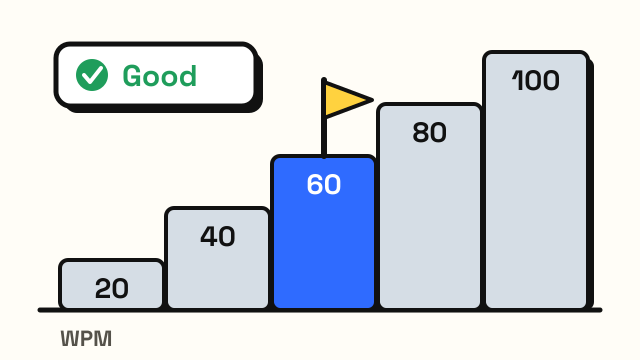
Yes, 60 words per minute (WPM) is a good typing speed. It is half again as fast as the 40 WPM usually quoted as the adult average, it clears the 40 WPM bar that US federal and California state clerical jobs set, and it sits above the 52 WPM average found in the largest published study of keyboard typing. At 60 WPM a 1,000-word essay takes under twenty minutes, so typing stops being the slow part of the work. This guide gives a verdict for each speed from 20 to 120 WPM and shows how to move up one level.
How good is 60 WPM, really?
Three reference points put 60 WPM in context:
- The everyday average. Typing tutors, teachers and hiring guides usually describe the average adult as typing around 40 WPM, with a common range of 35 to 45. The average typing speed guide explains where that figure comes from.
- Measured data. Researchers at Aalto University and the University of Cambridge analysed 136 million keystrokes from about 169,000 people who took an online typing test and found an average of 51.56 WPM, with a standard deviation of about 20 (Dhakal et al., 2018). The slowest 10% typed below about 26 WPM, and the fastest reached 120 WPM or more. Those volunteers chose to take a typing test, so they probably type more than most people, and 60 WPM still beats their average.
- Job requirements. The US Office of Personnel Management asks for 40 WPM on a five-minute sample with three or fewer errors for Clerk-Typist and Office Automation positions, and California requires at least 40 WPM on a five-minute proctored test for jobs that need a typing certificate. The typing speed for jobs guide lists what other roles ask for.
The one thing 60 WPM does not guarantee is accuracy. A 60 WPM score at 90% accuracy means one wrong character in ten, and in real work each of those costs more time than the fast typing saved. Treat 60 WPM at 97% or better as the real benchmark.
What does each typing speed mean?
The bands below follow the ranges widely used by typing tutors and job sites, so treat them as a guide rather than an official scale.
| Typing speed | Verdict | Where it sits | What it feels like |
|---|---|---|---|
| 20 WPM | Beginner | Well below average | Looking for keys, two to four fingers |
| 30 WPM | Below average | Close to the slowest tenth of test takers in the study | Knows the layout, hesitates on rarer letters |
| 40 WPM | Average | The adult rule of thumb, the federal clerical bar | Fine for email and school work, slow for volume typing |
| 50 WPM | Above average | Roughly the study average | Mostly touch typing, some pauses |
| 60 WPM | Good | Above both averages, clears most job bars | Steady touch typing, typing is no longer the bottleneck |
| 70 WPM | Very good | Entry level for transcription work | Few pauses, rhythm across whole sentences |
| 80 WPM | Excellent | More than one standard deviation above the study average | Rarely looks away from the screen, few corrections |
| 100 WPM | Expert | Rare without deliberate practice | Competitive typists, professional transcription |
| 120+ WPM | Elite | The fastest typists in the study | Leaderboard territory on any typing site |
One caution: the text matters as much as the typist. Short common words give a higher number than a paragraph with numbers and punctuation, and net WPM, which subtracts errors, is lower than raw WPM. Our guide on how WPM is calculated explains the difference, and the typing test shows both figures.
Is 40 WPM good?
40 WPM is average and useful. It is the number most often given as the adult norm, and it is the exact bar two large public employers publish for clerical work. It is enough for email, essays and most office jobs, but not for high-volume data entry or transcription. If you still look at the keyboard at 40 WPM, learning touch typing is the fastest route up, because looking down caps most people around this speed.
Is 80 WPM good?
80 WPM is excellent. In the Aalto data it is more than one standard deviation above the mean, which puts it among the faster typists even in a group that chose to take a typing test. It covers every common job requirement, including the 60 to 80 WPM range usually asked of general transcriptionists. People at this speed are almost always daily touch typists, and the study found that faster typists also made fewer mistakes, not more.
Is 100 WPM good?
100 WPM is an expert speed that few people reach without deliberate practice. The fastest typists in the Aalto study went past 120 WPM, so 100 is not the ceiling, but it is far above anything a job will ask for. At this level the gains come from rhythm, accuracy under pressure and stamina. Typing Race and the daily leaderboards are a better test of where you stand than a plain speed test.
Typing speed benchmarks by age and grade
Children are judged against school goals, which are lower than adult norms and rise each year. The Common Core writing standards used in most US states give no WPM figure, but they set a keyboarding benchmark by output: grade 4 students should type at least one page in a single sitting, grade 5 students two pages and grade 6 students three pages (CCSS W.4.6, W.6.6). Schools translate those into WPM targets of their own, so a child typing 25 to 30 WPM in upper elementary school is doing well. Among adults, method and daily practice predict speed far better than age does.
How to check where you stand
A single one-minute run can land 10 WPM above or below your true speed. To get a number you can trust:
- Warm up for two minutes first.
- Take the 3 minute typing test, which smooths out a fast or slow start and matches the length of many job assessments.
- Repeat it three times on different days and use the middle score.
- Read the accuracy next to the WPM. If it is under 95%, the speed number is flattering you.
If a job asks for five minutes, practice with the 5 minute typing test so the length feels normal. After any test here you can download a free typing certificate that records speed, accuracy and test length.
How to move up one level
- Under 40 WPM. Learn the home row and stop looking at the keys. Work through the typing lessons in order and read how to stop looking at the keyboard.
- 40 to 60 WPM. Accuracy and rhythm. Slow down until you pass 97%, then raise speed a little at a time while drilling your most-missed keys. Add capital letters and punctuation, because real text is full of them.
- 60 to 80 WPM. Stamina and consistency. Longer tests, a daily ten-minute session and games that punish hesitation, such as Typing Challenge.
- 80 WPM and up. Measure against people, not averages. Race in Typing Race, post a score to the leaderboards, and work on numbers and symbols, usually the slowest keys left.
The guide on how to type faster lays out a full plan, and how to improve typing accuracy covers the habits that keep errors low while speed climbs.
Frequently asked questions
Is 60 WPM good for a job?
Yes. Most office, support and administrative roles ask for 35 to 60 WPM, and the US federal clerical standard is 40 WPM on a five-minute test. Transcription roles often ask for 70 WPM or more, so that is the main exception.
Is 60 WPM fast for a 13 year old?
Yes. Many teenagers who type daily for school reach 40 to 60 WPM, so 60 WPM at 13 is at the top of that range and above the figure usually quoted as the adult average.
Is 60 WPM good with 90% accuracy?
The speed is good but the accuracy is not. At 90% you mistype one character in ten, and fixing those errors costs more time than the extra speed saves. Slow down until accuracy is at least 95%, then build the speed back up.
How long does it take to get from 40 to 60 WPM?
A touch typist at 40 WPM can often reach 60 WPM in a few weeks of short daily practice. Someone who looks at the keys has to learn touch typing first, which usually slows them down briefly before they overtake their old speed. See how long it takes to learn touch typing.
Sources
- Dhakal, V., Feit, A. M., Kristensson, P. O. and Oulasvirta, A. (2018). Observations on Typing from 136 Million Keystrokes. Proceedings of the 2018 CHI Conference on Human Factors in Computing Systems.
- US Office of Personnel Management. General Schedule Qualification Standards: Group Coverage Qualification Standard for Clerical and Administrative Support Positions.
- CalCareers, State of California. Typing Certification Information.
- Common Core State Standards Initiative. English Language Arts Standards, Writing, Grade 4, Standard 6 and Grade 6, Standard 6.