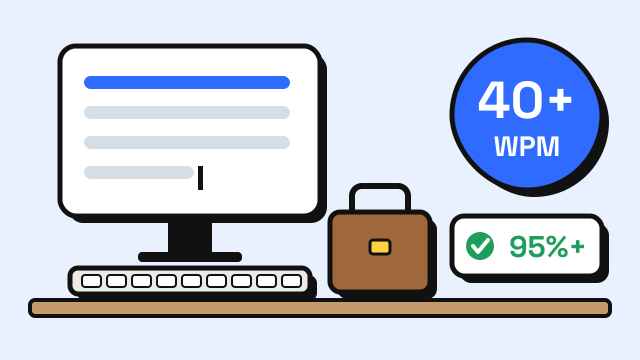
Most office jobs that test typing ask for somewhere between 35 and 60 words per minute (WPM), usually with an accuracy of 95% or higher. A few public employers publish an exact bar: US federal clerk-typist and office automation positions require 40 WPM on a five-minute test, and California state jobs that need typing ask for a five-minute certificate showing at least 40 WPM. Transcription and court reporting sit far higher, while most programming jobs do not test typing at all. This guide covers expectations by role, how the tests work and how to prepare.
What typing speed do most jobs require?
There is no single industry standard. Each employer sets its own number, and many job listings never mention one. When a posting does name a speed, it usually falls into the ranges below. They are the figures commonly seen in job ads and hiring guides, not official requirements.
| Role | Speed commonly requested | Why |
|---|---|---|
| Receptionist, general office | 30–45 WPM | Emails, forms and notes, mixed with phone and in-person work |
| Customer support (chat and email) | 35–50 WPM | Several conversations at once, where slow replies hurt |
| Administrative assistant | 40–60 WPM | Letters, minutes, calendars and documents all day |
| Data entry clerk | 40–60 WPM, sometimes measured in keystrokes per hour | Volume work where speed and errors both show up in output |
| Medical or legal secretary | 50–75 WPM | Long documents full of specialist terms |
| General transcriptionist | 60–80 WPM and up | Typing what you hear, often with pausing and rewinding |
Two published standards are worth knowing because they show how employers think about the test, not just the number:
- US federal government. The Office of Personnel Management (OPM) requires 40 WPM for Clerk-Typist (GS-2/4), Office Automation Clerk/Assistant and positions with "(Typing)" or "(Office Automation)" in the title. The words per minute are based on a five-minute sample with three or fewer errors (OPM).
- State of California. Jobs that require a typing certificate ask for at least 40 WPM on a test that must be five minutes long and proctored in person or virtually (CalCareers).
So 40 WPM over five minutes, with very few mistakes, is a sensible baseline for clerical work. If you want to see where you fall against the general population first, the guide to average typing speed has the wider picture.
Typing speed by job type
Data entry
Data entry is the job most closely tied to typing speed, but it is often measured differently. Many data entry tests count keystrokes per hour (KPH) instead of WPM, because the work is numbers, codes and short fields rather than sentences. A typing test that reports keystrokes per hour, like our 3 minute typing test, gives you a comparable figure. Accuracy matters even more here: one wrong digit in an invoice or account number can cost more than a slow day.
Administrative and office roles
Office and admin roles usually ask for 40 to 60 WPM. In practice you will also be judged on formatting, spelling and how well you handle capital letters, punctuation and numbers, since real documents are full of them. If those slow you down, the lessons on capital letters and punctuation and numbers and symbols are a good use of a week.
Customer support
Chat and email support reward steady, accurate typing more than raw speed, and a typo in a customer-facing message looks careless. Around 40 WPM with high accuracy covers most support roles.
Transcription
General transcription jobs often ask for 60 WPM or more, because typing what you hear means pausing, rewinding and checking. Court reporting is a different level altogether and uses stenotype machines, not regular keyboards. The National Court Reporters Association's Registered Professional Reporter exam dictates at 180, 200 and 225 WPM across three five-minute legs and requires 95% accuracy on each (NCRA).
Medical and legal
Medical and legal secretaries and transcriptionists deal with long, precise documents full of specialist vocabulary. Postings commonly ask for 50 to 75 WPM, and accuracy is critical because a wrong drug name or a wrong date in a contract is a real problem, not a cosmetic one.
Programming
Programmers type all day, but typing speed is rarely tested. Most of the job is reading, thinking and debugging. Comfortable touch typing still helps, especially with symbols like brackets and semicolons, but no serious software employer screens on WPM.
How are job typing tests run?
Formats vary, but most share a few features:
- Length. Three and five minutes are the most common. Longer tests smooth out a lucky start, which is why OPM and California both use five minutes. If you only ever practice one-minute tests, a five-minute test can feel surprisingly long.
- Text. You usually copy a paragraph of ordinary prose, sometimes with numbers and punctuation. Data entry tests may use forms or number fields instead.
- Scoring. Most report net WPM, which subtracts errors, plus an accuracy percentage or an error count. Some set a maximum number of errors rather than an accuracy figure, as OPM does. Our guide on how WPM is calculated explains the difference between net and raw WPM.
- Setting. Tests are taken online before an interview, at a staffing agency or on-site. Formal certificates for government jobs are usually proctored.
Why accuracy matters as much as speed
Employers care about accuracy because errors cost time twice: once to make and once to find and fix. A common requirement is 95% accuracy or better. OPM's rule of three errors in five minutes is even stricter in practice: at 40 WPM over five minutes you type about 200 words, so three errors is well under 2% of words.
If you have to choose, a slightly lower speed with clean accuracy almost always looks better than a high speed full of mistakes. The guide on how to improve typing accuracy covers how to get there.
How to prepare for a job typing test
- Find out the format. Ask the recruiter how long the test is, whether it counts net or gross WPM, and what score they want. It is a normal question.
- Practice at the real length. Use the 5 minute typing test for most job tests, or the 3 minute test if that matches. Get used to staying focused for the whole time.
- Choose harder text. Practice on Medium or Hard difficulty so capitals, punctuation and longer words don't surprise you.
- Aim for accuracy first. If your accuracy is below 95%, slow down until it comes back up. Speed follows.
- Fix your weakest keys. The result screen lists the keys you miss most. Spend a few minutes on them each day with the typing lessons.
- Warm up on test day. Type for two or three minutes before you start. Cold fingers make more mistakes.
- Use a familiar keyboard if you can. Laptop and desktop keyboards feel different. If the test is remote, check your keys work with the keyboard tester.
To stay motivated over a few weeks, mix in short rounds of Typing Race, where your WPM is your running speed.
Can I show a typing certificate?
Some employers accept or ask for a typing certificate. After a 1, 3 or 5 minute test here you can download a free typing certificate with your WPM, accuracy, test length and date. Be clear about what it is: it is self-issued and not proctored, so it shows your own result rather than an official credential. If a job asks for a proctored test, like the California certificate above, you will still need to take one.
Frequently asked questions
Is 40 WPM good enough for a job?
For many office, reception and support roles, yes. It meets the published federal and California clerical standards of 40 WPM, provided your accuracy is high. Admin, data entry and transcription jobs often ask for more.
What is a good typing speed for data entry?
Many data entry postings ask for 40 to 60 WPM, or an equivalent keystrokes-per-hour figure, with high accuracy. Number-heavy work also rewards practice on the number row and numeric keypad.
Do employers check net or gross WPM?
Most report net WPM, which accounts for errors, or set a maximum number of errors. Ask the employer if you are unsure, and practice with a test that shows both.
How long are job typing tests?
Three and five minutes are the most common lengths. The US federal and California state standards both use a five-minute sample.
Sources
- US Office of Personnel Management. Group Coverage Qualification Standard for Clerical and Administrative Support Positions (proficiency requirements for typing and office automation positions).
- California Department of Human Resources, CalCareers. Typing Certification Requirements.
- National Court Reporters Association. Registered Professional Reporter (RPR).