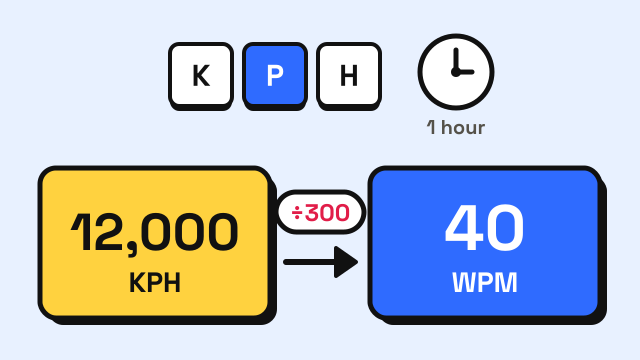
Keystrokes per hour (KPH) is the number of keys you press in an hour of typing. To turn KPH into words per minute, divide by 300: 9,000 KPH is about 30 WPM, and 15,000 KPH is about 50 WPM. To go the other way, multiply WPM by 300. The factor is 300 because a typing "word" is five characters and an hour has 60 minutes (5 × 60). Data entry employers often use KPH instead of WPM, and published requirements usually fall somewhere between 5,000 and 10,000 KPH. This guide explains the formula, gives a conversion table, and shows what real job postings ask for.
What does keystrokes per hour mean?
KPH measures raw keying volume. Every key press that produces a character counts, whether it is a letter, a digit, a space or a punctuation mark. Nobody types for a full hour during a test, so the figure is projected from a shorter sample: a five-minute test with 1,000 keystrokes works out to 1,000 × 12 = 12,000 KPH.
The unit exists because much data entry work is not prose. Account numbers, postcodes, dates and product codes do not come in words, so counting words per minute makes little sense. Counting key presses treats a digit, a letter and a dash the same way, which suits forms and spreadsheets.
KPH is usually a gross figure. It tells you how fast your fingers move, not how much clean text you produced. That is why employers almost always pair it with an accuracy or error limit.
How do you convert KPH to WPM?
The conversion rests on two standard rules: one word is five characters, and one hour is 60 minutes.
WPM = KPH ÷ 300
KPH = WPM × 300
Some quick examples:
- 6,000 KPH ÷ 300 = 20 WPM
- 10,000 KPH ÷ 300 = about 33 WPM
- 45 WPM × 300 = 13,500 KPH
If you want characters or keystrokes per minute in between, divide KPH by 60. 12,000 KPH is 200 keystrokes per minute, which is 40 WPM. Our guide on WPM to CPM covers that middle step in more detail, and how WPM is calculated explains the five-character rule.
One caution: the result is a raw WPM, because KPH counts every press, including ones you later corrected. If your accuracy is 95%, your net WPM will be a little lower than the converted figure.
KPH to WPM conversion table
| KPH | Keystrokes per minute | Approximate WPM |
|---|---|---|
| 3,000 | 50 | 10 |
| 5,400 | 90 | 18 |
| 6,000 | 100 | 20 |
| 7,000 | about 117 | about 23 |
| 8,000 | about 133 | about 27 |
| 9,000 | 150 | 30 |
| 10,000 | about 167 | about 33 |
| 12,000 | 200 | 40 |
| 15,000 | 250 | 50 |
| 18,000 | 300 | 60 |
| 21,000 | 350 | 70 |
| 24,000 | 400 | 80 |
The table assumes plain text with one press per character. On numeric or mixed data the link to WPM is looser, because there are no real words and some characters need Shift.
What KPH do data entry jobs ask for?
Requirements vary by employer, so treat any single number as an example, not a standard. Here is what a few published postings and role descriptions state:
| Employer and role | Stated requirement |
|---|---|
| U.S. Census Bureau, Statistical Clerk (Data Transcriber), USAJOBS postings | 5,400 keystrokes per hour or 25 WPM, with 3 or fewer errors, on a five-minute sample |
| City of Windsor (Canada), Data Entry Operator | Minimum 6,000 keystrokes per hour with 60% minimum accuracy |
| Victorian Electoral Commission (Australia), data entry operator for computer counts | Numeric data entry of 7,000–10,000 keystrokes per hour |
Commercial job boards and staffing agencies commonly cite 8,000 to 10,000 KPH for entry-level data entry, with 10,000 KPH or more treated as fast. In WPM terms, that whole range sits between roughly 18 and 33 WPM, which shows why KPH targets can look large on paper but are within reach for most people who type daily.
Two details matter more than the headline number:
- What is being typed. A numeric test on a 10-key pad, an alphanumeric form test and a prose test all produce different KPH for the same person. Ask which one you will take.
- How errors are handled. Some tests subtract errors from the keystroke count, some cap the number of errors, and some set a separate accuracy percentage. A fast result with many errors can still fail.
For more on numeric speed, see how to type numbers faster. For job roles that ask for typing more broadly, see typing speed for jobs and typing jobs from home.
Is 10,000 KPH good?
10,000 KPH is about 167 keystrokes per minute, or roughly 33 WPM on plain text. For prose typing that is a little below the commonly cited adult average of around 40 WPM. For data entry, especially numeric data, it is a solid working speed and meets the upper end of the requirements listed above.
Here is a rough guide to how KPH bands are often described for data entry work. The labels are the informal ones job sites use, not official grades.
| KPH | How it is usually described |
|---|---|
| Under 6,000 | Still building speed |
| 6,000–8,000 | Meets many entry-level requirements |
| 8,000–10,000 | The range many data entry roles ask for |
| 10,000–12,000 | Fast for data entry |
| 12,000+ | Very fast, common among experienced operators |
If you type prose at 50 WPM, your KPH on prose is already around 15,000. The challenge with data entry is keeping that pace on digits, codes and mixed case, where most people slow down.
How do I measure my KPH on EnjoyTyping?
Every typing test on this site shows keystrokes per hour along with WPM, raw WPM and accuracy. On this site, KPH counts each character you type, including characters you later delete with Backspace. It does not count Backspace or Shift themselves. That makes it the same measure as raw WPM × 300.
A few tips for a figure you can quote:
- Use a longer test. The 5 minute typing test matches the length many employment tests use, and a longer sample smooths out a lucky or slow start. The 3 minute typing test is a good middle ground.
- Report accuracy too. Employers care about errors as much as speed. Quote both numbers together.
- Practice digits separately. If the job is numeric, work through Course 5: Numbers & Symbols in our typing lessons before you test.
- Keep proof. The typing certificate records your WPM and accuracy. You can multiply the raw WPM by 300 if an application asks for KPH.
If accuracy is holding back your score, how to improve typing accuracy has drills that help.
Frequently asked questions
How many WPM is 8,000 KPH?
8,000 KPH divided by 300 is about 27 WPM. That is gross speed, so subtract a little for any errors to estimate net WPM.
How many KPH is 40 WPM?
40 WPM × 300 = 12,000 KPH. That assumes one key press per character on ordinary text.
Does KPH include mistakes?
Usually yes. KPH is a count of key presses, so mistyped characters count too. Employers handle errors separately, either with an accuracy percentage or a maximum number of errors allowed.
Is KPH the same as KSPH?
Yes. KSPH (keystrokes per hour) and KPH are two abbreviations for the same measure. Some employers also write "strokes per hour".
Sources
- USAJOBS. Statistical Clerk (Data Transcriber), U.S. Census Bureau National Processing Center.
- U.S. Office of Personnel Management. Data Transcriber Series 0356.
- City of Windsor. Data Entry Operator job posting.
- Victorian Electoral Commission. Data entry operator role statement.
- Wikipedia. Words per minute.