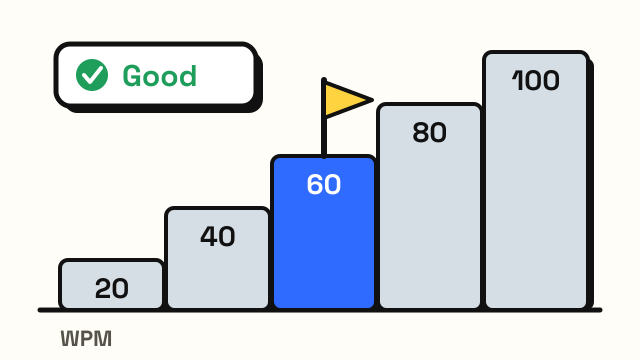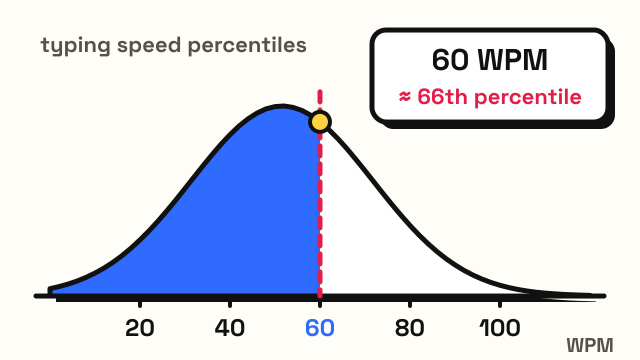
If you type 52 words per minute (WPM) on a keyboard, you are roughly in the middle: about half of typists are faster and half are slower. That midpoint comes from the largest published study of keyboard typing, which measured about 169,000 volunteers and found an average of 51.56 WPM with a standard deviation of about 20 WPM. From those two numbers you can estimate a percentile for any speed: 40 WPM lands near the 28th percentile, 60 WPM near the 66th, 80 WPM near the 92nd, and 100 WPM puts you in roughly the top 1%. The table below gives the full picture, and the rest of this guide explains where the numbers come from and how far to trust them.
What does a typing speed percentile mean?
A percentile tells you the share of people who type slower than you. If your speed is at the 70th percentile, about 70% of the group types slower and about 30% types faster. It is a ranking, not a grade, so the number depends entirely on who is in the group.
That last point matters more than it sounds. A percentile against office workers, against students and against people on a competitive typing site will give three different answers for the same 60 WPM. The figures in this guide compare you with people who chose to take an online typing test, which is the best large sample available, but it probably leans faster than the general public.
Typing speed percentile table
The estimates below assume the study's results follow a roughly bell-shaped curve around 51.56 WPM with a standard deviation of 20.2 WPM. They are a back-of-the-envelope conversion, not figures published by the researchers, so read them as "about" rather than exact.
| Your WPM | Estimated percentile | Roughly faster than | Rough rank |
|---|---|---|---|
| 20 | 6th | 1 in 17 typists | Beginner |
| 30 | 14th | 1 in 7 | Below average |
| 40 | 28th | 1 in 4 | Average for everyday use |
| 50 | 47th | Half | Middle of the pack |
| 60 | 66th | 2 in 3 | Good |
| 70 | 82nd | 4 in 5 | Very good |
| 80 | 92nd | 9 in 10 | Top 10% |
| 90 | 97th | 29 in 30 | Top 3% |
| 100 | 99th | 99 in 100 | Top 1% |
| 120+ | 99.9th+ | Almost everyone | Elite |
The researchers' own summary is a useful check on the middle of the table: they describe most computer users as typing around 30 to 60 WPM, with some reaching over 120. In the table above, the band from 30 to 60 WPM covers about half of all typists, and the top end thins out quickly above 90.
Real typing data is not perfectly bell-shaped. Speeds cannot go below zero, and a small group of very fast typists stretches the top end, so the true share above 100 WPM may be a little larger than a strict bell curve predicts. Treat the top rows as "rare" rather than as a precise rank.
Where do these numbers come from?
The source is a 2018 study by researchers at Aalto University and the University of Cambridge, published at the CHI conference on human-computer interaction (Dhakal et al., 2018). Volunteers took a free online typing test and copied 15 randomly chosen sentences, producing about 136 million keystrokes in total. The average speed was 51.56 WPM, the fastest typists reached about 120 WPM, and the researchers released the anonymised data so others can study it.
Three features of the study shape how you should read the percentiles:
- The sample is self-selected. People who visit a typing test site probably type more than the average person. That is one reason the everyday rule of thumb for the average typing speed is closer to 40 WPM than 52.
- The sentences were random. Participants could not memorise the text, so speeds are a little lower than on tests that repeat the same passage.
- It measured physical keyboards. Phone typing is a separate scale, covered below.
The study also found that faster typists made fewer errors, not more, and that the fastest used rollover, pressing the next key before releasing the previous one, on 40 to 70% of keystrokes. Participants who had taken a typing course did about as well as those who had not, which suggests practice habits matter more than a certificate of training.
What percentile is 60 WPM?
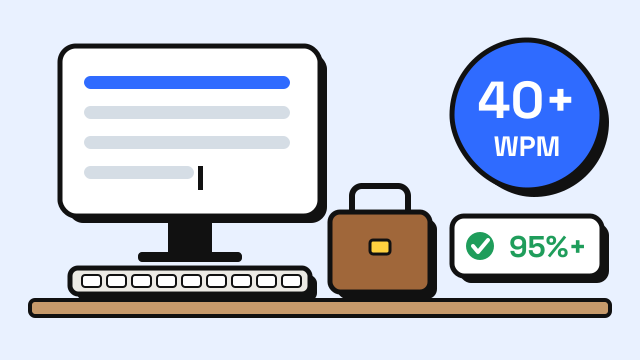
At 60 WPM you are faster than about two out of three people in the study, around the 66th percentile. Against the general public, where 40 WPM is the usual average, you are likely higher still. It also clears the 40 WPM bar many clerical jobs set. The guide Is 60 WPM good? goes through what each speed means for work and school.
What percentile is 100 WPM?
100 WPM is about 2.4 standard deviations above the study's mean, which works out to roughly the top 1%. Even if the real tail is a bit fatter than a bell curve suggests, 100 WPM is rare without years of daily typing or deliberate practice. The fastest typists in the world go far beyond it, but they are a handful of people, not a percentile band.
How does phone typing compare?
A follow-up study from the same group measured about 37,000 volunteers typing on phones and found an average of 36.2 WPM, with the fastest reaching about 85 WPM (Palin et al., 2019). Most typing in that study was done with two thumbs. So a phone score of 50 WPM ranks much higher among phone typists than a keyboard score of 50 WPM does among keyboard typists. Compare like with like: use the mobile typing test for your phone percentile and the regular test for your keyboard. The mobile typing speed guide has more detail.
How to find your own percentile fairly
A single lucky run can move you 10 percentiles. To get a rank you can trust:
- Warm up for two minutes before the run you count.
- Use a longer test. The 3 minute typing test smooths out a fast start or a stumble far better than a 30-second sprint.
- Use net WPM. The study's speeds are for text people had to get right, so compare your net figure, not raw speed. Our guide on how WPM is calculated explains the difference.
- Take the middle of three results from different days, then look it up in the table.
- Check accuracy. A top-20% speed at 88% accuracy is not a top-20% typist. Aim for 95% or higher.
The typing test here shows WPM, raw WPM, accuracy and your most-missed keys, so you have everything you need for an honest lookup.
How to move up the rankings
The table is steepest in the middle: going from 40 to 60 WPM moves you from about the 28th to the 66th percentile, a bigger jump than any other 20 WPM step. That is good news, because the 40 to 60 range is also where most people improve fastest once they stop looking at the keys.
- Below 40 WPM: learn to touch type. Work through the typing lessons from the home row up.
- 40 to 60 WPM: slow down until accuracy passes 97%, then raise speed a little at a time. The guide on how to improve typing accuracy covers the habits that help.
- 60 to 80 WPM: build stamina with longer tests and games that punish hesitation, like Typing Challenge.
- 80 WPM and up: a percentile against the public stops being useful. Rank yourself against other fast typists in Typing Race and on the daily leaderboards.
For a step-by-step plan, see how to type faster.
Frequently asked questions
What percentile is 70 WPM?
About the 82nd percentile, using the study's average of 51.56 WPM and standard deviation of about 20. In other words, roughly four out of five people who take an online typing test are slower than 70 WPM.
Is 50 WPM above average?
It is right around the middle of the largest published typing study, close to the 47th percentile. Against the everyday rule of thumb of about 40 WPM for adults, 50 WPM is above average.
Why do typing sites show different percentiles for the same speed?
Each site ranks you against its own users and its own texts. A site popular with competitive typists has a faster crowd, and a test made of short common words produces higher speeds. A percentile is only meaningful next to the group it was measured on.
What percentage of people can type 100 WPM?
Based on the study's average and spread, roughly 1% of people who take online typing tests reach 100 WPM. The share of the general public is likely lower, because the study's volunteers probably type more than most people.
Sources
- Dhakal, V., Feit, A. M., Kristensson, P. O. and Oulasvirta, A. (2018). Observations on Typing from 136 Million Keystrokes. Proceedings of the 2018 CHI Conference on Human Factors in Computing Systems.
- Aalto University (2018). The traits of fast typists discovered by analysing 136 million keystrokes. News release.
- University of Cambridge (2018). What makes a faster typist? Research news.
- Palin, K., Feit, A. M., Kim, S., Kristensson, P. O. and Oulasvirta, A. (2019). How do People Type on Mobile Devices? Observations from a Study with 37,000 Volunteers. Proceedings of MobileHCI 2019.