The fastest honest way to score higher on a typing test is to remove the things that cost you points without having anything to do with your skill: a bad setup, cold hands, a rushed start and the wrong way of fixing typos. Sit properly, warm up for two minutes, read the first line before you begin, type at a pace you can hold, fix errors quickly or not at all depending on the test, and judge yourself by the average of several runs rather than your single best. None of this makes you a faster typist overnight, but it lets the score show your real speed. Below is what to do before, during and after a test, and why tricks that inflate the number are not worth it.
What should you do before a typing test?
Most points are lost before the first keystroke. Check these five things:
- Your seat and screen. Sit so your elbows are roughly level with the keyboard and the text is at eye level. Hunching over a laptop makes you look down and slows your reach. The typing posture guide has a short checklist.
- Your keyboard. On a keyboard you have not used before, find Backspace, Shift and Enter first, since their size and position vary. On your own computer you can check that every key registers with the keyboard tester.
- Your hands. Cold, stiff fingers miss keys. Warm them up and type a few drills; the typing warm-up exercises guide gives a two-minute routine.
- Distractions. Close chat apps and turn off notifications. A pop-up halfway through a 1-minute test can cost you several words.
- The rules of the test. Find out how long it is, whether Backspace is allowed and how errors are scored. A job test that penalizes every uncorrected error needs a different approach from one that only counts correct characters.
How should you pace yourself during the test?
Start slower than you think you should. Nerves push most people to sprint in the first few seconds, which leads to a cluster of errors and a broken rhythm that takes a while to recover from. A steady pace at about 90% of your top speed usually produces a higher net score than a fast start followed by a stumble.
A few habits help:
- Read ahead. Keep your eyes a word or two in front of what your fingers are typing. This keeps you from pausing between words.
- Keep an even rhythm. Try to leave about the same gap between keystrokes, even on hard words. Slowing down slightly for a long word costs less than missing it.
- Do not look at the keys. Every glance down breaks your place in the text. If you still look down often, practise with how to stop looking at the keyboard before worrying about test day.
- Do not watch the timer or live WPM. Checking the clock pulls your eyes away from the text. Look at the result when the test ends.
On EnjoyTyping the typing test timer starts with your first keystroke, not when the page loads, so you can read the opening line calmly before you begin.
Should you fix typos or keep going?
It depends on how the test scores errors. Here is how the common methods compare:
| Scoring method | What a typo costs | Best approach |
|---|---|---|
| Correct characters only (net WPM) | The wrong character does not count | Fix a typo in the current word quickly; do not go back several words |
| Gross WPM minus error penalty | A fixed penalty per uncorrected error | Fix errors you notice right away |
| Errors allowed up to a limit | Failing if you go over the limit | Fix everything; accuracy matters more than speed |
| Backspace disabled | The error stays in the text | Slow down slightly and keep going |
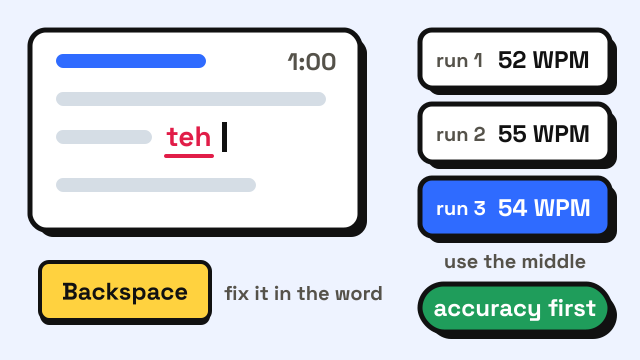
The common rule across all of them: fix a mistake while you are still in the same word, then move on. Going back three or four words to repair one letter usually costs more time than the error itself.
On this site, a typo you correct still counts against your accuracy, because the keystroke was wrong when you made it. Your WPM, though, only counts characters that match the text in the end. So fixing a typo quickly is still worth it for your WPM. How WPM is calculated explains the exact formulas.
How much does accuracy matter for your score?
More than most people expect. Every wrong character is a character that does not count, plus the time spent typing it and, often, fixing it. If your raw WPM is 70 and your net WPM is 55, slowing down a little will probably raise your score, because you are losing about a fifth of your output to errors.
Employers often set an accuracy bar as well as a speed bar. For many US federal clerical jobs, the typing standard is 40 WPM on a five-minute test with three or fewer errors (Bureau of Indian Education). That is a modest speed but a strict error limit, so a careful 45 WPM passes where a sloppy 60 WPM may not. A commonly cited target for office work is around 95% accuracy or better; how to improve typing accuracy covers how to get there.
How many times should you take a typing test?
Once tells you little. Short tests swing a lot from run to run, depending on the text and how settled you are. For a fair picture of your speed:
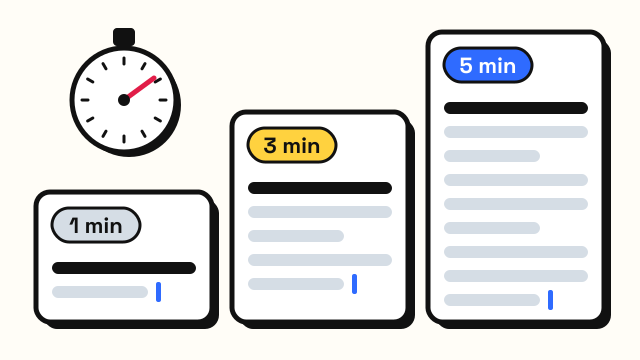
- Take the 1 minute test three times and use the middle score, not the best one.
- For job preparation, use the 5 minute typing test. Many formal standards use five minutes, and it shows whether you can keep your pace up.
- Use Medium or Hard difficulty if the real test will include capitals and punctuation. A score on easy text can flatter you.
If your median score is close to the level a job asks for, practise until it is comfortably above it. On test day, nerves and an unfamiliar keyboard often cost a few WPM.
Why avoid tricks that inflate your score?
You can find ways to make a number go up: choosing the easiest text over and over, retaking a 15-second test until one run comes out unusually high, or using software that types for you. These scores do not hold up when it matters.
- Job tests are run by the employer. Many employers, staffing agencies and public agencies test you themselves, sometimes with a supervisor present. California state departments, for example, only honor typing certificates from a five-minute test with at least 40 WPM, issued within the last four years (CalCareers). A lucky online run does not carry over.
- A false number hides what to practise. If your recorded speed is higher than your real speed, you cannot tell whether practice is working.
- Leaderboards are for fair play. If you submit scores to the leaderboards, they only mean something when everyone types the test themselves.
An honest result is also what makes a free typing certificate worth sharing: it says exactly what it is, a self-reported result from a free online test.
How can you raise your score for real?
The tips above stop you losing points. Gaining them takes regular practice. Short daily sessions, often suggested at 10 to 20 minutes, do more over a few weeks than one long session the night before a test. Work on the keys you miss most in the typing lessons, and mix in typing games to keep practice from getting dull. For a fuller plan, read how to type faster, and check typing speed for jobs to see what level you are aiming for.
Frequently asked questions
Is it better to type fast or accurately on a typing test?
Accurately first. Errors reduce your net WPM and can fail you outright on tests with an error limit. Type at a pace where you make few mistakes, then raise your speed gradually.
Should I use Backspace on a typing test?
Yes, if the test allows it and the typo is in the word you are typing. Fix it quickly and move on. Do not go back several words, and if Backspace is disabled, just keep going.
Why is my typing test score lower than my practice score?
Nerves, an unfamiliar keyboard, harder text and a longer test all pull a score down. Practise on the same test length and difficulty as the real one, and warm up beforehand.
How long should I practise before a typing test?
Short daily sessions over several weeks work better than cramming. On the day itself, a two-minute warm-up and one short practice test are enough.
Sources
- Bureau of Indian Education. Vacancy announcement: typing proficiency requirement (40 WPM on a five-minute test with three or fewer errors; applicants may self-certify, and selecting officials may verify with a performance test).
- CalHR / CalCareers. Typing Certification (certificates from a five-minute test, at least 40 WPM, issued within the last four years).