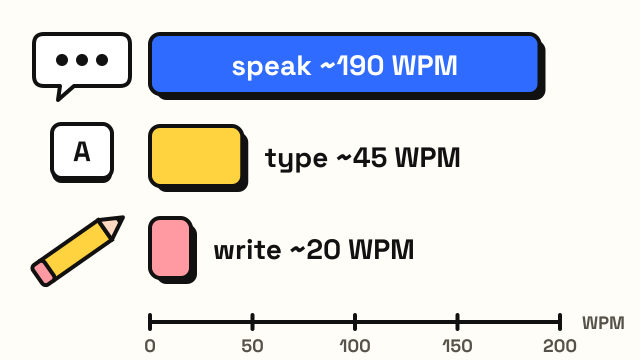
Speaking is by far the fastest way to produce words. Everyday conversation in English runs at roughly 150 to 200 words per minute (WPM), keyboard typing for most adults sits around 40 to 50 WPM, and handwriting is slower still, at roughly 13 to 30 WPM depending on how neat it needs to be. So most people talk about three to four times faster than they type, and type about twice as fast as they write by hand. The rest of this guide puts the research figures side by side, explains why the gaps exist, and looks at when each method makes sense.
How fast do people speak, type and write?
The table collects the best-known measured figures. Each row comes from a different study with its own people, texts and rules, so read it as a rough map rather than a precise ranking.
| Method | Typical speed | Where the figure comes from |
|---|---|---|
| Handwriting, copying text | about 13–20 WPM (adults), 26–36 WPM (students, neat vs. fast) | Commonly cited norms; student figures quoted by Franzsen and Stewart (2014) |
| Typing on a phone | 36 WPM average | Palin et al. (2019), about 37,000 volunteers |
| Typing on a keyboard, composing your own words | 19 WPM average | Karat et al. (1999) |
| Typing on a keyboard, copying text | 33 WPM (everyday users) to 52 WPM (online test takers) | Karat et al. (1999); Dhakal et al. (2018) |
| Stenotype, court reporter certification | 180–225 WPM | NCRA Registered Professional Reporter skills test |
| Reading aloud | 183 WPM average | Brysbaert (2019) meta-analysis |
| Conversation | 196 WPM average, 111–291 WPM range | Yuan, Liberman and Cieri (2006), phone conversations |
| Silent reading, non-fiction | 238 WPM average | Brysbaert (2019) meta-analysis |
Two rows are not "producing" text at all, but they help frame the rest. Silent reading shows how fast the brain can take language in, and reading aloud shows the speed of speech when the words are already chosen for you.
How fast do people talk?
The most often quoted figure for conversation comes from a study of the English Switchboard corpus, a collection of 2,438 recorded phone conversations between strangers. Adding up the words from both speakers and dividing by the length of each call gave an average of 196 WPM, with individual conversations ranging from 111 to 291 WPM (Yuan, Liberman and Cieri, Interspeech 2006).
Prepared speech is slower. Presentations, lectures and audiobooks are commonly said to run at about 150 to 160 WPM, because speakers slow down to be clear and pause between ideas. Reading a text aloud averages about 183 WPM for adults in English (Brysbaert, 2019).
Either way, ordinary speech is several times faster than ordinary typing. Even very fast typists at 100 WPM are typing at roughly half of normal conversation speed.
How fast do people type?
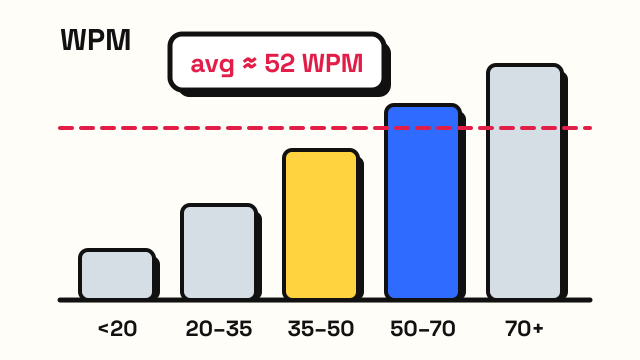
On a physical keyboard, the figure most typing sites give for the average adult is about 40 WPM. The largest published typing study, with about 168,000 volunteers who took an online test, found an average of 52 WPM when copying short sentences (Dhakal et al., CHI 2018). Those volunteers chose to take a typing test, so they probably type more than most people. Our guide to average typing speed and the typing speed percentiles page show how those numbers are spread.
Two details make typing look slower in daily life than on a test:
- Composing is slower than copying. A study of everyday computer users found about 33 WPM when copying text but only about 19 WPM when writing new text (Karat et al., CHI 1999). Thinking about what to say, not finger speed, sets the pace.
- Phones are slower than keyboards. A study of about 37,000 volunteers measured an average of 36 WPM on smartphones, with two-thumb typing clearly faster than one finger (Palin et al., MobileHCI 2019). See mobile typing speed for more.
How fast is handwriting?
Handwriting is the slowest of the three for almost everyone. Commonly cited norms for adults copying text put the average around 13 WPM, with most people somewhere between about 5 and 20 WPM. A 2014 study of handwriting problems among university students in South Africa quotes norms of about 26 WPM when students are asked to write neatly and 36 WPM when they are asked to write as fast as they can on a short sentence-copying task (Franzsen and Stewart, 2014).
The gap between "neat" and "fast" is the key point. Handwriting speed can rise, but legibility drops quickly as it does. Typing has no such trade-off: the letters on screen look the same at 30 WPM and at 90 WPM.
Why is speaking so much faster than typing?
A few things add up:
- One action per sound vs. one action per letter. Speech produces a whole syllable in one smooth movement of the mouth. Typing needs a separate key press for every letter, space and punctuation mark, about six presses for an average English word.
- Lifelong practice. Most people have spoken every day since early childhood. Typing practice usually starts much later and is far less regular.
- No visual checking. People rarely watch their mouths while talking, but many typists still glance at the keys, which breaks their rhythm. Learning to stop looking at the keyboard is one of the biggest single jumps in typing speed.
- Errors cost less. A slip of the tongue is usually ignored. A typo has to be spotted, deleted and retyped.
Is voice typing faster than keyboard typing?
For short messages on a phone, usually yes. A study by researchers at Stanford, the University of Washington and Baidu compared speech recognition with the iPhone keyboard and found that dictating English was about three times faster than typing, with fewer errors left in the final text (Ruan et al., 2016). The test used short phrases, and participants could fix mistakes by voice or by keyboard.
For longer or more careful writing, the picture is less clear. Dictation struggles with names, code, formatting and editing, such as moving a sentence or replacing two words in the middle of a paragraph. A keyboard is still the faster tool for those jobs, and it works in quiet offices, libraries and shared rooms where talking out loud is not an option.
What does this mean for your own typing?
Speech sets a ceiling that very few typists ever reach, but the gap shrinks with practice. Moving from 30 WPM to 60 WPM halves the time you spend typing anything, and that matters far more in daily work than matching the speed of conversation.
A practical way to close part of the gap:
- Learn touch typing. The free typing lessons start at the home row and add one row at a time.
- Measure, then retest weekly. Take the typing test a few times and track the middle score, not the best one.
- Practice typing what you hear. Typing from speech links the two skills directly, which is useful for note-taking and transcription. Listen and Type reads words aloud for you to type.
- Compare against real work. Our guide on how long it takes to type 1,000 words turns your WPM into minutes for real documents.
Frequently asked questions
How many times faster is speaking than typing?
Conversation averages close to 200 WPM in one large study of phone calls, while the average adult types around 40 to 50 WPM on a keyboard. That makes speaking roughly three to five times faster for most people. Against a 100 WPM typist, the gap falls to about two times.
Is typing faster than handwriting?
Yes, for most adults who type regularly. Handwriting is commonly put at about 13 to 30 WPM depending on neatness, while keyboard typing averages around 40 to 50 WPM. Even a slow typist at 25 WPM often matches or beats careful handwriting.
Can anyone type as fast as they speak?
Only with special equipment or training. Court reporters use a stenotype machine, which presses several keys at once to form whole syllables or words, and the main US certification asks for 180 to 225 WPM. On a regular keyboard, a few competitive typists have passed 200 WPM in short races, as the fastest typists in the world guide shows, but holding that pace for minutes is extremely rare.
Does taking notes by hand or by keyboard work better?
It depends on the goal. Typing captures more words per minute, which helps when you need a near-complete record. Handwriting forces you to summarise because you cannot keep up, which some people find helps them think about the material. Many people use typing for meetings and handwriting for study notes.
Sources
- Yuan, J., Liberman, M. and Cieri, C. (2006). Towards an Integrated Understanding of Speaking Rate in Conversation. Proceedings of Interspeech 2006.
- Brysbaert, M. (2019). How many words do we read per minute? A review and meta-analysis of reading rate. Journal of Memory and Language, 109, 104047.
- Dhakal, V., Feit, A. M., Kristensson, P. O. and Oulasvirta, A. (2018). Observations on Typing from 136 Million Keystrokes. Proceedings of the 2018 CHI Conference on Human Factors in Computing Systems.
- Palin, K., Feit, A. M., Kim, S., Kristensson, P. O. and Oulasvirta, A. (2019). How do People Type on Mobile Devices? Observations from a Study with 37,000 Volunteers. Proceedings of MobileHCI 2019.
- Karat, C.-M., Halverson, C., Horn, D. and Karat, J. (1999). Patterns of Entry and Correction in Large Vocabulary Continuous Speech Recognition Systems. Proceedings of the CHI 1999 Conference on Human Factors in Computing Systems.
- Ruan, S., Wobbrock, J. O., Liou, K., Ng, A. and Landay, J. (2016). Speech Is 3x Faster than Typing for English and Mandarin Text Entry on Mobile Devices. arXiv:1608.07323.
- Franzsen, D. and Stewart, A. (2014). Identifying handwriting problems at a higher education institution in South Africa. South African Journal of Occupational Therapy, 44(1), 3–8.
- National Court Reporters Association. Registered Professional Reporter (RPR) skills test requirements.